TheraJoy Review: Turning Joy-Cons Into a Pocket Calm Device
The pitch
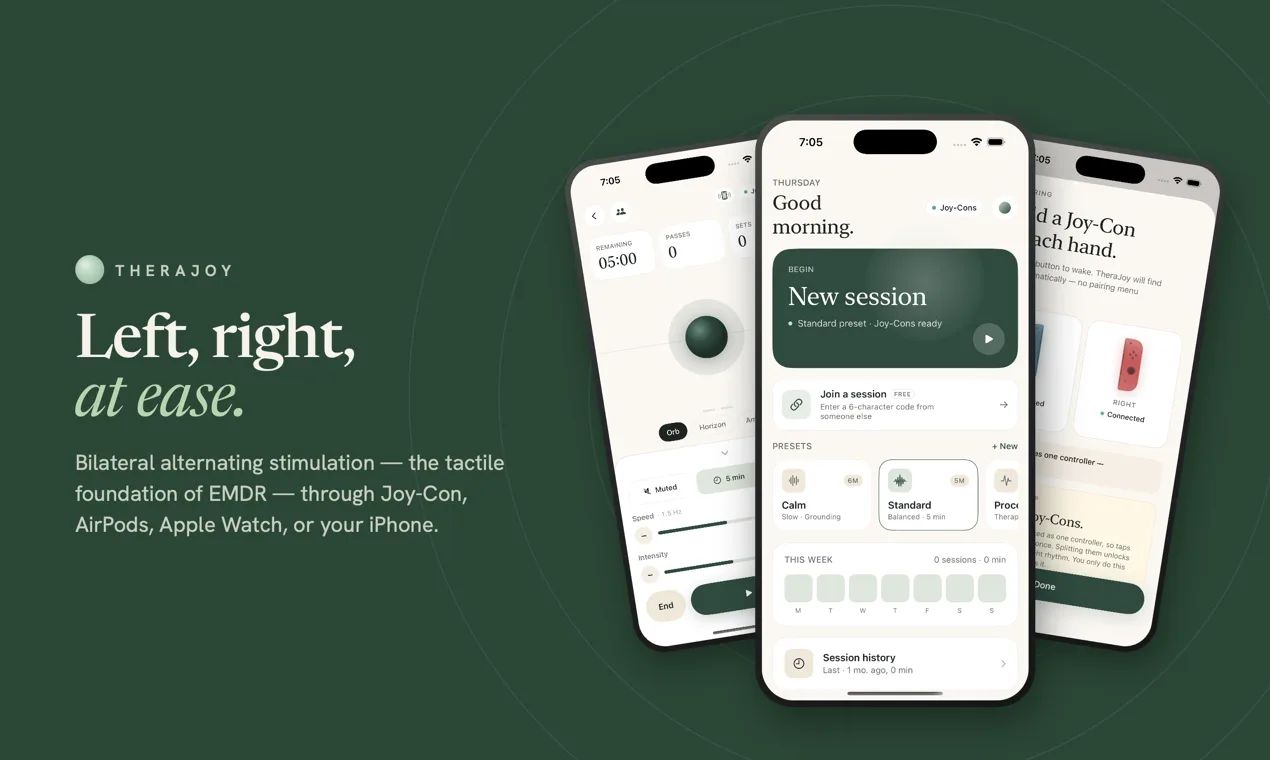
Every so often an app comes along with a genuinely odd premise, and TheraJoy qualifies. It takes the Nintendo Joy-Cons sitting in your drawer, the little controllers from the Switch, and turns them into a two-handed relaxation device. Hold one in each hand and the app fires gentle haptic pulses that alternate left, right, left, right, at a tempo you control. The technique it borrows is called bilateral stimulation, the same left-right rhythm used in EMDR therapy, and the idea is that a steady tactile beat helps your nervous system settle.
It is a clever bit of hardware repurposing, and the tagline sums up the ambition neatly: "A calmer way to regulate, tap by tap." We spent time with it to see whether the novelty holds up as an actual tool. Short version: it is more thoughtful than we expected, with a couple of real caveats.
Setup and first impressions
Getting started is refreshingly painless. You download the app on an iPhone, pair your Joy-Cons over Bluetooth the same way you would any controller, and you are running in a couple of minutes. If you do not own Joy-Cons, the app can also route haptics through the iPhone itself or through AirPods, and support for Apple Watch is listed as coming. Those fallbacks work, but the two-in-each-hand Joy-Con setup is clearly the intended experience, and it is the one that feels best.
One detail we appreciated immediately: there are no accounts. You do not sign up, hand over an email, or wade through a permissions gauntlet. The app states it collects no analytics and no personal data, and there is a private journal that lives entirely on your device. In a category crowded with wellness apps that treat your feelings as a data harvest, this restraint stands out.
The presets and controls
TheraJoy ships with four presets that cover most use cases without any fiddling:
- Calm runs slow and gentle, aimed at winding down.
- Standard is the middle-of-the-road starting point.
- Process uses a more active rhythm.
- Custom hands you the full control panel.
That custom mode is where the app earns its keep. You can set the speed anywhere from a very slow 0.25 Hz up to a brisk 3 Hz, adjust the haptic intensity, and control both how many passes make up a set and how long a session runs. It is granular without being overwhelming, and once you find a combination you like, the presets mean you rarely have to touch it again.
On the visual side you get three ambient options, called Orb, Horizon, and Ambient, or you can skip the screen entirely with an eyes-closed mode. The eyes-closed option is, honestly, the one we reached for most; the whole point is to get off screens, and being able to pocket the phone and just feel the pulses is the app at its best.
The remote sessions feature
The standout feature is remote sessions. Using a six-character pairing code, an EMDR clinician can guide a client's session from a distance, adjusting the stimulation in real time. For therapists running teletherapy this is genuinely useful, and it signals that the developers understand the clinical context they are borrowing from rather than just cargo-culting the aesthetics.
Who it is for, and who it is not
If you already find rhythmic touch soothing, own Joy-Cons, and live in the Apple ecosystem, this is an easy and inexpensive thing to try. It also makes sense as an adjunct for people working with an EMDR therapist who wants a between-session grounding option, though that is a conversation to have with your clinician, not a decision to make solo.
It is not for you if you are on Android, since the app is iOS-only, and it is a weaker experience if you do not have Joy-Cons and rely on phone-only haptics. Most importantly, it is not for anyone looking for treatment. TheraJoy is explicitly not a medical device, it does not diagnose, treat, or cure any condition, and it is not a substitute for working with a licensed therapist. It is a self-regulation aid, and it is honest about being exactly that.
Pros and cons
- Pro: Clever, low-cost use of hardware you may already own.
- Pro: Genuinely private, with no accounts, analytics, or data collection.
- Pro: Deep customization plus sensible presets for people who do not want to fiddle.
- Pro: Remote-session support is a thoughtful touch for clinicians.
- Con: iOS-only, so Android users are out of luck.
- Con: Best experience really does want Joy-Cons; phone-only haptics are a compromise.
- Con: Not a medical device, so anyone expecting a treatment should look elsewhere and see a professional.
Verdict
TheraJoy is a small app with a clear point of view. It does one thing, delivering adjustable bilateral haptics for self-regulation, and it does it with unusual respect for your privacy and intelligence. It will not fix a clinical problem, and it should not pretend to. But as a calm-down tool that repurposes gear gathering dust in your closet, it is a genuinely nice find. If the premise appeals to you, it is worth a look at https://www.therajoyapp.com/. Just go in understanding it for what it is: a well-made wellness aid, not a piece of medicine.